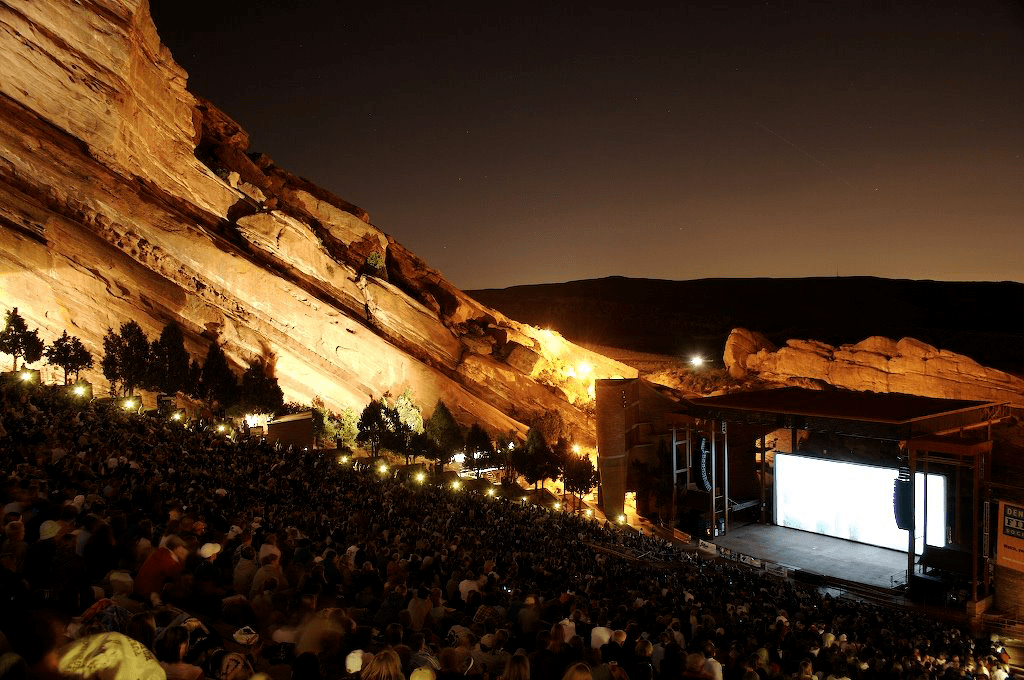
Red Rocks Amphitheater in Denver, Colorado. Photo from Wikimedia Commons
By Elijah Johnston
The first time I watched the stunning Sept. 1 Phoebe Bridgers performance in an empty Red Rocks Amphitheater, I was blindsided by a thought: I was supposed to see this show at the beach. Back in January, Bridgers announced Summer tour dates opening for British pop band The 1975, and me and my friends made a plan to drive down and see them both in Jacksonville, Florida, followed by a weekend at the beach. I should’ve seen this in an arena, I thought, and here I am in my room like every other day this year. The venue and the circumstances might have changed, but thankfully the strength of the songs and performance did not.
You could say this for any of the thousands of musicians who had to cancel their plans for the foreseeable future, but it really seemed like 2020 was supposed to be Phoebe Bridgers’ year. In the three years since her esteemed debut Strangers in the Alps, the Los Angeles-based singer-songwriter had hit every conceivable step in the journey of a successful millennial musician. Her stages got bigger, her heroes became her peers and vice versa, and her constant mid-20s attitude of ironic humor and jarring honesty has made her personality something of a brand for legions of fans online. There are few other people in today’s music landscape as singular as Bridgers, and 2020 was promising to be a crowning year — a new album, a bunch of festivals, and a stadium tour opening for one of the biggest bands in the world. Obviously none of that happened the way it was intended to, but what’s happened instead shows why Bridgers is becoming such an important figure: her ability to adapt to anything.
Her adaptation extends beyond the situation and into the songs in the Red Rocks livestream. Save from a lackluster performance of her biggest hit “Motion Sickness” and a couple of hits late in the setlist, the rest of the hour long set is made up entirely of her new album Punisher. Bridgers and her band cut through a lot of the special effects and unnatural sound of the album in favor of jangly guitars, impassioned yells, and a refreshing lack of polish. Quiet songs become louder, fast songs become rockier, and the amorphous blobs of sound that surround much of the recordings gain more form and rhythm in a live setting. The album can be a little same-y in its melodies and instrumentation, but these similarities are smaller in view in this live setting, with the band cutting through the fog to give a clearer sense of structure and lyrical direction.
One of the biggest challenges facing anyone doing a livestream with no audience is generating energy onstage when there is none to react to. An empty venue as large as Red Rocks is a daunting place to play with no audience feedback, but Bridgers and her band are up to the tall task. There are constant jokes and self-deprecating comments between songs, typically between Bridgers and her drummer Marshall Vore. Sometimes the silence is a little strange, but these pauses are smoothed out by joke sound effects, off-the-cuff anecdotes, and shots of atmospheric B-roll. These awkward intimacies would normally be smoothed over by the collective excitement of a crowd, but it’s a welcome luxury that Bridgers is able to bypass rough spots with production tricks.
Bridgers doesn’t overstay her welcome in the gaps between songs, fitting for someone who named her new album Punisher after a slang term for the types of people that talk way too much. Instead, her lyrics do the heavy lifting, spinning webs of lost love, a haunted past, and an uncertain future. Whatever that future looks like, it seems likely that Bridgers will be there, singing to our faces or to cameras or whatever is needed, shapeshifting into whatever the moment needs. In an era of adversity and rapid change, it’s Phoebe’s consistency that keeps her on people’s minds. After remembering I planned on seeing this set live, it dawned on me that it might not have been that different. It’s this notion that excites me about this show and this album and the rest of Phoebe’s career — you don’t become a voice of a generation if they think you’re not going anywhere.
 Bulldog Beat