By Jostlyn Lord
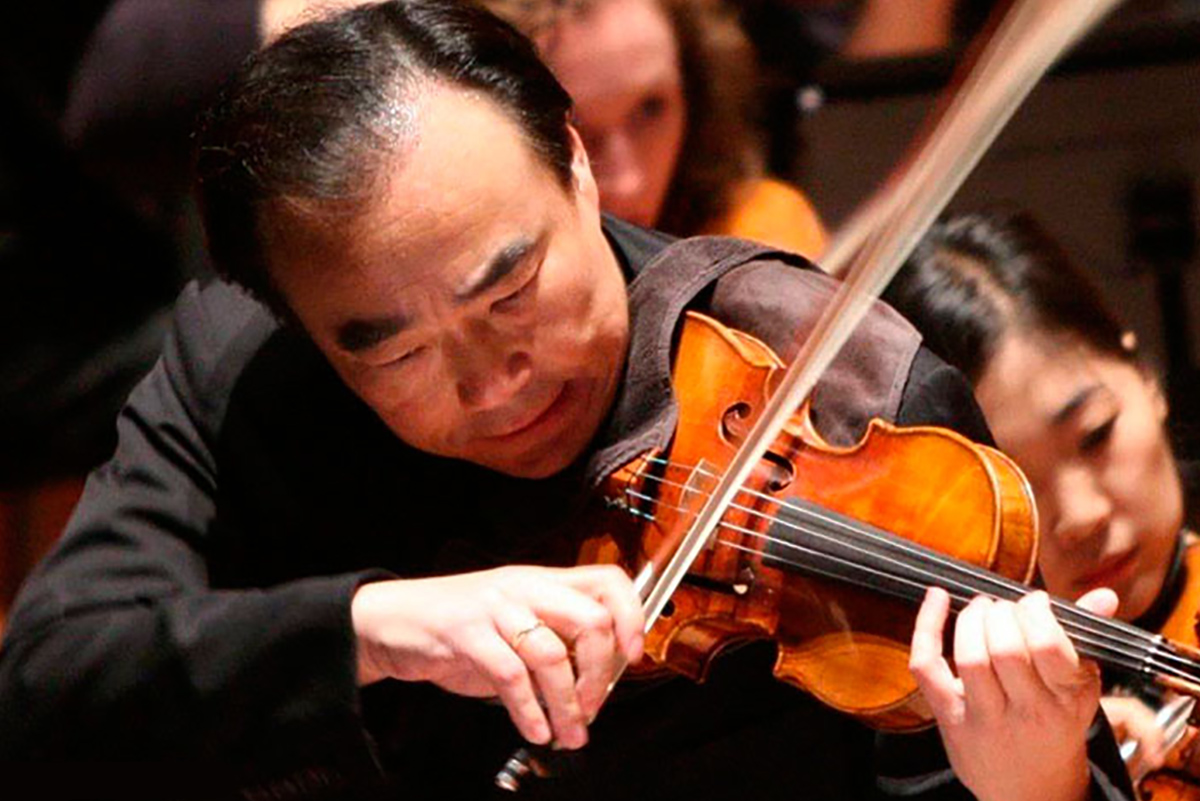
Picture this: you’re at a concert in an intimate performance hall. You’re in the first row, and you look lovingly into the proscenium stage in front of you. You can see the sweat on the brow of the violinist on stage and the passion in his eyes as he plays a melancholy section of “Composer’s Holiday” by Lukas Foss. The violinist closes his eyes as he moves his bow, feeling the music that he plays for you.
This is what the Chamber Music Society of Lincoln Center’s Artist Series aimed to bring to audiences in its live streamed performance by violinist Cho-Liang Lin. While the series is dubbed “Front Row,” it doesn’t quite deliver the experience that it seeks to emulate.
On Sept. 30 at 3 p.m., University of Georgia Presents streamed Cho-Liang Lin’s last live performance of the year to an audience likely made up of Hugh Hodgson School of Music students and local classical music fans. The performance was recorded in March, after being rushed onto the stage in an effort to beat the shutdown caused by the COVID-19 pandemic, and originally live-streamed on May 31 by CMS. The stream included a live set of introductions made by Wu Han and David Finkle of CMS, a video about Lin’s experience at his last concert and issues with COVID-19 and a live Q&A in which Han and Finkle asked Lin questions submitted before the live-stream.
When I tuned in to the performance on the UGA Presents website, I was shown a small video embedded across a third of my computer screen. The video was surrounded on top and bottom by text introducing the series, providing me with information about CMS. At the bottom of the page there was a link to the program of the performance. I thought this was a convenient touch that reminded me of the good old days when I would receive a program while walking into the theater before a play. The pre-performance videos added something unique to the concert-going experience, as they provided an intimate insight into Lin’s life and into the stories of the three pieces that he played during his concert. These pieces were “Composer’s Holiday” by Lukas Foss, “Larghetto” by Antonin Dvorak and “Souvenir de Florence” by Peter Ilyich Tchaikovsky. As someone who knows very little about classical music, I found these introductions helped me to appreciate the music that I was hearing.
During these pieces, Lin’s own musicality became obvious through the use of camerawork. Close ups featured his hands, showing how quickly and fluidly he uses them, and his face, which portrayed the melancholy of a slow section and the sass of high notes. His emotion was more obvious to audiences watching this streamed performance than the audience that watched his performance live, because cameras were placed much closer than a seat in the house of a theater. The quality of the video was clear and professional, however I still found it difficult to watch because the website did not let me enter full screen mode for the embedded video. Instead, I had to watch the concert on one third of my screen, watching a very small Lin play very big notes.
While the visual aspect of the video was good quality, the hardware used to capture this performance could not quite convey the nuances of Lin’s sound. Many of the low notes played by both Lin and his fellow performers were difficult to hear through my laptop speakers, even when they were at max volume. Similarly, the piano or pianissimo moments of Lin’s performance were lost on me, due to the drawbacks of technology.
During my experience of the concert, the video and audio lagged and were not in sync at two separate periods, and I found that my own attention span wandered throughout the hour and 17 minute performance. Unlike at a live concert, I was distracted by the myriad other things I could be doing in my home, such as cooking or taking out the trash. I suppose I could have tried to emulate the concert experience by dimming the lights in my home or perhaps printing out the program that UGA Presents offered me online, but I’m afraid it still would have been too obvious that I was watching Lin’s performance on a small computer screen, rather than a proscenium stage. I could not escape the fact that I was alone watching Lin, because UGA Present’s streaming service did not offer a comments section where audience members could interact. While Lin’s performance and the music were undeniably beautiful, my experience with this concert was lacking, leaving me bored and unsatisfied, ready to close out the video even before the Q&A with Lin was over.
 Bulldog Beat
There definitely is something incredibly unique about hearing a performance live and in-person, and has been hard to adjust when it’s so fascinating to experience someone pouring their heart and soul into a piece they have put so many hours into.
LikeLike